The Productivity Paradox
AI That Works vs. AI You Work For

The Paradox
New research from Berkeley Haas caught my attention this week: "AI Doesn't Reduce Work—It Intensifies It" (HBR, Feb 9, 2026).
Aruna Ranganathan and Xingqi Maggie Ye studied 200 employees at a tech company from April to December 2025. Their findings were striking: AI created real productivity gains, but it also created unsustainable intensity. Employees were managing multiple AI threads simultaneously, constantly context-switching, and feeling "always juggling" even as the work felt productive. The tools made them faster at tasks, but didn't free them from tasks.
Most of us are stuck in this same loop. We use ChatGPT as a better Google, Claude as a faster StackOverflow. We're still the ones doing the work—AI just helps us do it quicker.
The Four Stages
I've noticed a pattern in how people interact with AI tools. Most never make it past Stage 2:
- Stage 1: No system: Manual, ad-hoc, often skipped.
- Stage 2: AI as online assistant: It helps, you execute.
- Stage 3: AI executes: You approve, it runs.
- Stage 4: AI as proactive assistant: Set it, forget it, runs forever.
Here's how this played out for me.
The Shift
I wanted to stay on top of tech innovation—follow key blogs in AI, programming, and systems—and get a morning brief with new articles delivered to me via text. A simple enough goal, but the way I pursued it evolved dramatically through each stage.
Stage 1: No system.
I'd passively scan Hacker News and Twitter when I remembered. It was irregular, inconsistent, and I missed the ritual on most days. Or worse, I obsessively doom-scrolled!
Stage 2: ChatGPT as assistant.
I asked ChatGPT to write me an RSS parser script. Then I copied the code, debugged it, and ran it manually. It was better, but I was still the bottleneck—checking output, copy/pasting, babysitting the process. Back to being at the mercy of remembering the ritual.
Stage 3: OpenClaw executes.
Then came OpenClaw. I told Claw Clawssen, yes that's the name: "Build me an RSS feed checker for these 92 blogs. Filter for today's articles. Summarize them." It wrote the Node.js script, tested it, and showed me the results. I approved, and the whole thing took one conversation.
Stage 4: OpenClaw as infrastructure.
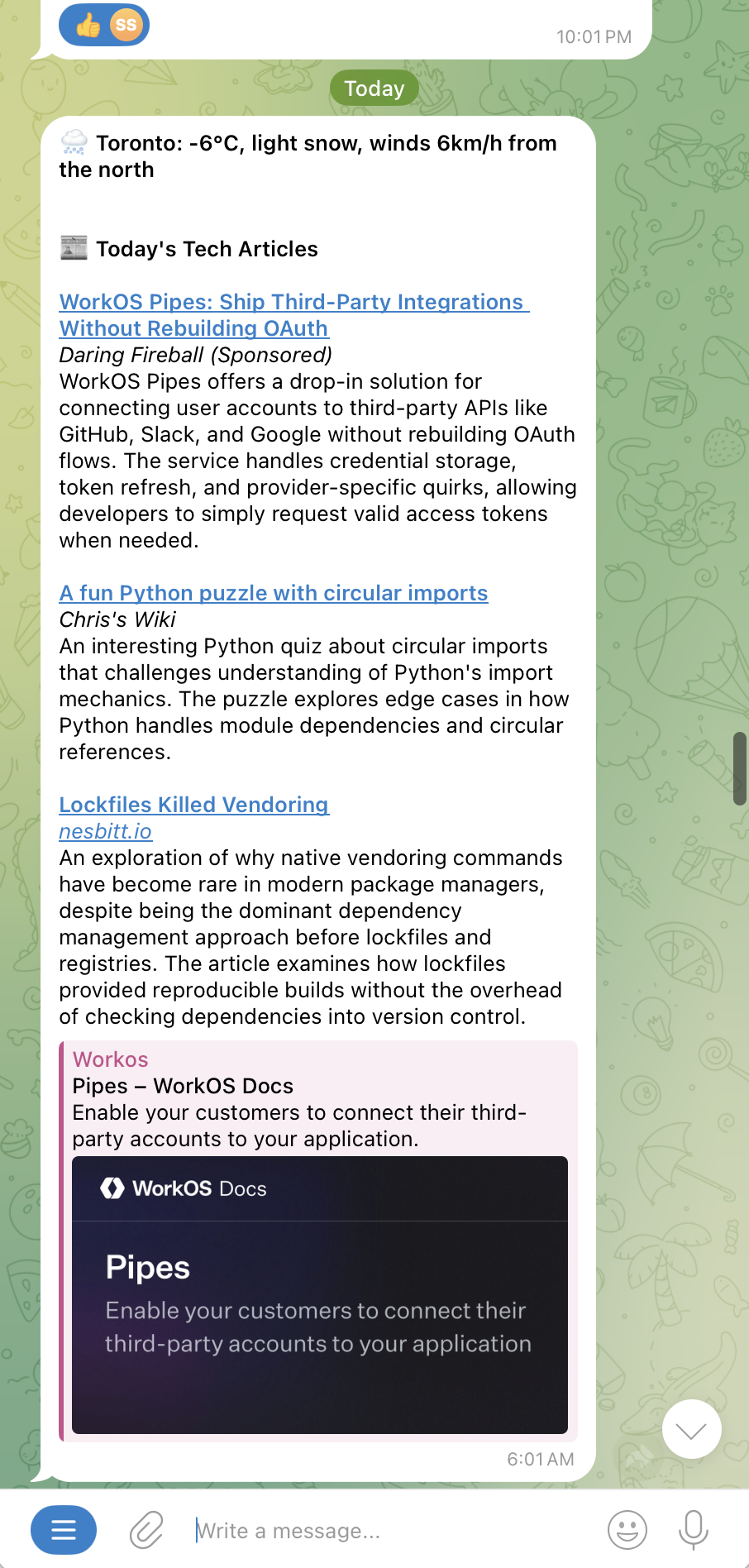
OpenClaw created a cron job that runs every morning at 6am. It fetches 92 feeds, filters programmatically by publish date (which saves tokens), runs only the AI/tech articles through summarization, fetches the weather, formats everything, and delivers it to my Telegram. Zero intervention. Runs forever.
From 45 minutes of manual work to zero. Not "faster"—eliminated.
The Difference
Most AI tools are reactive—you ask, they answer, and you're still in the loop. OpenClaw is something different: proactive infrastructure. It has persistent memory that knows your context across sessions, scheduled autonomy that works while you sleep, and tool access to read files, run scripts, and send messages. It's not a chatbot. It's a chief of staff.
What This Unlocks
I'm not "more productive" in the sense of doing more tasks faster. I'm productive because entire categories of work have disappeared. The morning brief happens whether I think about it or not, and the cognitive load is simply gone.
This is what Stage 4 thinking looks like: don't use AI to help you work—deploy AI to work for you.
What's Next
I've been running hands-on workshops on building this kind of system—covering everything from setting up OpenClaw on your own hardware to core concepts like memory, identity, and scheduled tasks, to real use cases that actually save time.
Next session: Friday, Feb 13 at 2pm EST (virtual). If you're tired of AI tools that make you faster at being busy, come learn to build AI that makes you less busy.
If you're interested in joining me, reach out on LinkedIn or X. 🦅